
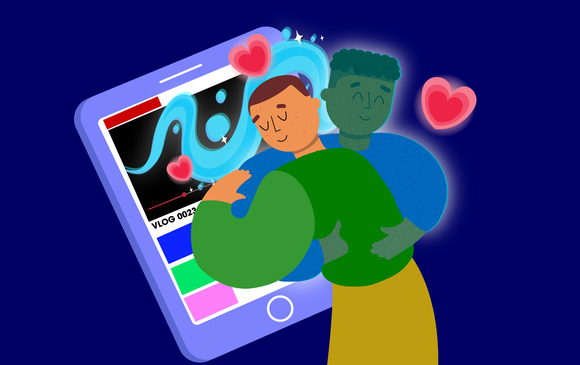
As coaches and mental health professionals, we’re seeing a major shift in how people fulfill their need for connection: parasocial relationships.
Being a child of the 60s who grew up with late 70s pop culture our relationships with our heroes was through the media, their albums, films, TV shows. We plastered the walls of our bedrooms with posters, torn from magazines, Smash Hits was always a great source.
In the digital, always on world that we inhabit today of social media, vlogging, podcasts, and more, it is easier than ever, and perhaps a little enchanting, to feel like we are “friends” with people we have never actually met.
A parasocial relationship is a one-sided psychological bond where someone invests emotional energy, time, and loyalty into a creator or celebrity who is entirely unaware of their existence. While these connections can offer comfort, they can also become a coping mechanism that masks deeper loneliness or social anxiety.
So how do you spot if those social interactions are crossing the line into an unhealthy fixation:
🔺 Neglecting real-world relationships: Choosing to stay in and watch a livestream over spending quality time with actual friends or family.
🔺 Severe emotional volatility: Feeling intense grief, anger, or personal betrayal over a creator’s life choices, content changes, or standard internet drama.
🔺 Financial over-investment: Spending beyond one’s means on subscriptions, merchandise, or tipping features just to get a brief moment of validation.
🔺 Unrealistic expectations of mutuality: Believing a creator “owes” them personal recognition or direct access because of the time they’ve spent supporting them.
Of course we’ve seen obsessive fandom before, does anyone remember the helplines when Robbie left Take That? But there was always a separation, even if it was purely a matter of limited access. One of the great things about social media is the way in which it allows us to connect with others that we would otherwise be disconnected from, but this is also one of the biggest dangers, the blurring of lines in a world where boundaries are not always clearly defined.
In coaching and therapy, our goal isn’t to demonise social media. It’s to help clients transition from passive, one-sided consumption to active, mutual connection. True emotional well-being requires a circle of support that can actually look back at us, listen, and support us in return. It requires us to remember that an influencer’s camera lens is a window, not an open door. While putting heroes on pedestals wasn’t healthy, perhaps it’s time to put them back at arms length.